Chapter 1: Day Zero
“He who has begun has half done. Dare to be wise; begin!”
— Horace, Epistles, Book I, 2 (c. 20 BC)
Suppose the chair of your Board called tonight with a single question. Not how the quarter is tracking. Not whether the new plant manager is working out. Just this: where is the business going, and by when?
You could talk for twenty minutes. Most CEOs can. Those twenty minutes would be accurate and well informed, full of real work by real people, and it still wouldn’t be a plan. A plan fits in a sentence, and somebody other than you can say it.
I call the condition of having no written plan Day Zero. It has nothing to do with the date on your employment contract. A CEO four years into a tenure, with no plan on paper, has not banked four years of progress. That CEO is standing on Day Zero — gathering information, attending meetings, managing the noise — and will stay there until somebody decides where the company is going and writes it down.
There is good news inside the bad. Day Zero is a state you are in, not a square on the calendar, which means you can leave it the morning you decide to, in your first week or your eleventh year.
The clock
What Day Zero hides first is time.
You probably believe your clock started the day you took the job. It started earlier, when the money went in: the day a sponsor closed the acquisition, the day the family recapitalized, the day the lender reset the covenants, or, in a company with no outside owner, the day somebody said out loud that something was wrong. Since then it has run without a pause, including every week you spent learning the names of the plant managers. Getting up to speed is a cost you carry, and the company cannot afford to wait it out.
So the first page of FORGE, the CEO operating program this book teaches, is four questions, answered in dates rather than impressions:
- When did the clock start? The close, the recapitalization, the refinancing — whatever put the money or the pressure into the business.
- When does it end? The exit window in the sponsor’s model, the maturity of the debt, the month the cash runs out.
- What is the next date on which somebody outside the company expects something from you? A Board meeting, a covenant test, the renewal of your largest contract.
- How many days have already been spent, and by whom?
The fourth question is the one that stings. A CEO placed by a private-equity (PE) sponsor usually inherits a clock that has been running for months, spent by an interim team or a search firm. Those days are gone whoever spent them. Write the number down anyway, and write whose they were, because the Board is counting them whether you are or not.
Then subtract, and write the days that remain as a number. “About two years” leaves room for comfort. “712 days” does not.
If nobody has ever told you when the clock ends, write what you believe and label it a belief. The label is information too.
What it looks like
Day Zero rarely feels like Day Zero from the inside. It feels like being busy.
Your calendar is full, and if somebody asked what last week’s meetings decided, you would struggle to name two things. Your leaders are working hard on projects you didn’t choose and couldn’t rank. At least three versions of the priority list are loose in the building — yours, the one in the Board deck, the one taped beside your operations chief’s monitor — and each can be defended. Ask four executives what the plan is and four confident answers come back, each one different, and nobody remarks on it.
One test settles it, and you can run it on anyone in the company tomorrow morning. Ask: what is this company trying to do this year? When the answer runs longer than a sentence, or reaches for a slide, the company is at Day Zero. How good the slide is doesn’t matter.
None of this is a shortage of effort. People in these companies are rarely lazy and almost never slow. What is missing is a system — a written plan, one owner for each piece of it, and a rhythm that holds the plan up against the numbers every month. Most CEOs I meet don’t have a strategy problem. They have a strategy that lives in one head (never concentrated, never translated into anybody else’s work, never deployed). Decisions queue outside that office door, the team puts in long weeks on work nobody picked, and the number does not move.
One sentence
Leaving Day Zero begins with a sentence.
I call it the one-sentence plan: where the company is headed and when it gets there, in words short enough that the people who have to deliver it can repeat it without looking at their notes. It isn’t a vision statement. A vision statement describes a mood. A one-sentence plan names a destination and pins a date to it, and if it doesn’t make at least one member of your team a little uneasy, it is not yet specific enough.
Write it badly first. Everybody’s first draft is too long, too soft and packed with words that do no work: excellence, innovative, partner of choice, growth with no number beside it. Let it be bad. You can’t cut a sentence you haven’t written.
Then cut it by one rule: strike every word that could appear in another company’s sentence. Excellence goes, because every company claims it. Customers stays only if the sentence says which ones. A figure stays, and a date, and any choice about where the company will concentrate. What survives belongs to your business and nobody else’s — a sentence that fits every company commits yours to nothing.
Then ask who could say it back to you today, unprompted, and write their names. If the list is empty, you have a sentence and not yet a plan. A plan is something other people carry.
Two cautions. First, the sentence is not the goal. A goal is one number, agreed with the Board and signed by the team, and it is the work of Objective, the second discipline. CEOs who confuse the two spend their first month arguing about a number before anyone has agreed on a direction. And the sentence will change. It is a first draft of the destination, and it will be rewritten before the hundred days are over. That is fine — a draft on paper can be corrected. A plan in your head can only be defended.
One more question belongs with it. What fills your weeks that appears nowhere in that sentence? Hold the answer, because the next chapter opens your calendar.
The readiness assessment
Your sentence tells you where you want to go. The readiness assessment tells you how far you are from being able to get there.
Ten statements, each scored 1 for yes or 0 for no. There is no partial credit and no “mostly.” Not sure is a no. Uncertainty is a no you haven’t admitted to yet.
Between them, the statements test four things. Three are about the plan: whether you can state it in one sentence, whether at least three of your direct reports could say that sentence back today, and whether the Board’s number exists on paper with a date (paper you have read, not a conversation you remember). Two are about the economics: whether you can name your top twenty customers by profit rather than by revenue without asking anybody, and whether you know what it costs to serve your smallest thousand orders. Three are about concentration: whether fewer than six initiatives are running, whether your top three priorities got more than half of last week’s hours, and whether you know what the company will stop doing this year and who is responsible for the stopping. And two are about the system: whether one person other than you has the job of running the operating cadence, and whether every recurring meeting on your calendar runs against a scorecard and closes with its decisions in writing.
Eight or more, and you are past Day Zero. FORGE will sharpen a plan you already have.
Four to seven is the score that worries me most. It means half a plan, and half a plan is dangerous precisely because it feels finished. A CEO who scores six walks around with the confidence of a plan and the protection of none.
Three or fewer, and you are at Day Zero, no matter how long you have held the title. Most CEOs land here the first time. That score says nothing about your ability, only that the system isn’t there yet.
Score it alone, before anyone else sees it. Once the team is watching, you start answering for the audience. Later, hand it to your leadership team, have each of them score it alone, and read out the totals without comment. If your chief financial officer (CFO) scores seven and your head of sales scores two, the gap is not a quarrel about the form. Two people are running two different companies under one name. Wherever the room splits, the person who scored zero speaks first. That person is usually right.
Treat the assessment as a reading, not a grade. There is no prize for raising it by next week. A score that rises because you reworded your answers has taught you nothing.
What you do not know
What would you most like to know about your own company that nobody in it can tell you? Every zero on the assessment and every blank on the clock page points at something like that. Write each one down, and beside it the name of the person who will find out and the date by which they will.
This list is worth more than everything you can already answer. What you know, you have priced into your decisions. What you do not know is where the surprises are hiding — the customer who costs more to serve than he pays, the initiative with no number on it, the Board expectation you have been estimating from the tone of a dinner.
A line with no name is a complaint. A line with no date is a wish. Every line must be answered, or closed on purpose, before anybody signs a number in Objective.
The rules of the road
FORGE runs on three rules.
Write it, don’t think it. A plan in your head is an intention, and an intention lasts until the first customer calls with a problem. Paper is where the plan leaves your head and enters the company.
Real numbers or a blank. Any figure written on these pages will get acted on. Acting is what the pages are for. Where you lack a figure, say so in writing and move the line to the list.
The team writes, not the CEO. You could complete every page of this program alone in a long weekend. You’d get good answers, and nobody would carry them. You own three things: the number, what stops, and the talent calls. The strategy belongs to the team.
Block the time before you start: two hours a week, every week, for the hundred days, treated as fixed. Two hours kept for fourteen weeks beats a heroic weekend once a quarter. Decide, too, who goes through it with you: your CFO, your head of operations, the few people who will install the system beside you.
When I run this myself, the beginning is deliberately light. I do not bury a CEO in theory on the first morning. The clock, the sentence, the score and the list are enough to start, and enough to show you where you stand.
The order
You can open the lessons in FORGE in any order, on any day. You cannot produce the working plans that way. Each discipline leaves behind one working plan, and each is the raw material for the next.
Why does everyone do Focus first, even the CEO who has read every book on the 80/20 principle and believes Focus is review? Because that CEO is usually the one who misapplies it six months later, and because Focus is the one discipline you mostly do alone. After Focus, work the disciplines in order: Objective, Roadmap, Govern, Execute.
One exception is deliberate. Pull forward the one lesson you cannot afford to wait for — the one your Bottleneck Profile points at. That profile comes out of a diagnostic in Chapter 3, and it shows which leadership role you are carrying that somebody else should hold. If yours is the Classic Bottleneck — you hold both the Visionary’s job of setting direction and the Prophet’s job of turning it into a running system — you name your Prophet during Objective, not after Roadmap. Once a number exists, somebody has to run the cadence against it, and that somebody cannot be you.
Pulling one lesson forward isn’t skipping a discipline. Govern cannot design an organization for a strategy nobody has written, and Execute cannot review targets nobody has chosen. The order is the sequence in which the pieces can bear weight.
Five disciplines, five working plans
Focus — concentrate on what matters. See the business through your own week and your own figures, and find where you are the bottleneck. Working plan: the State of the Business memo, a single page that carries your Bottleneck Profile.
Objective — own the number. Get the Board’s definition of good on paper, get the team’s honest belief about what it can deliver, measure the distance between them, and leave one meeting with one number. Working plan: the signed goal statement.
Roadmap — choose the critical few. Your leaders build the strategy in a fixed order and put it on the X-Matrix, a single page that ties the goal to three to five initiatives, the targets that show whether they are working, and one owner per line. Working plan: the signed X-Matrix, with the Stop-Doing List beside it.
Govern — structure follows strategy. Build the organization the strategy needs, not the one you inherited. Working plan: an org chart that names the Visionary, the Prophet and the Operators.
Execute — run the cadence. A few meetings on fixed dates, against a scorecard, run by the Prophet. Working plan: the live twelve-month operating calendar.
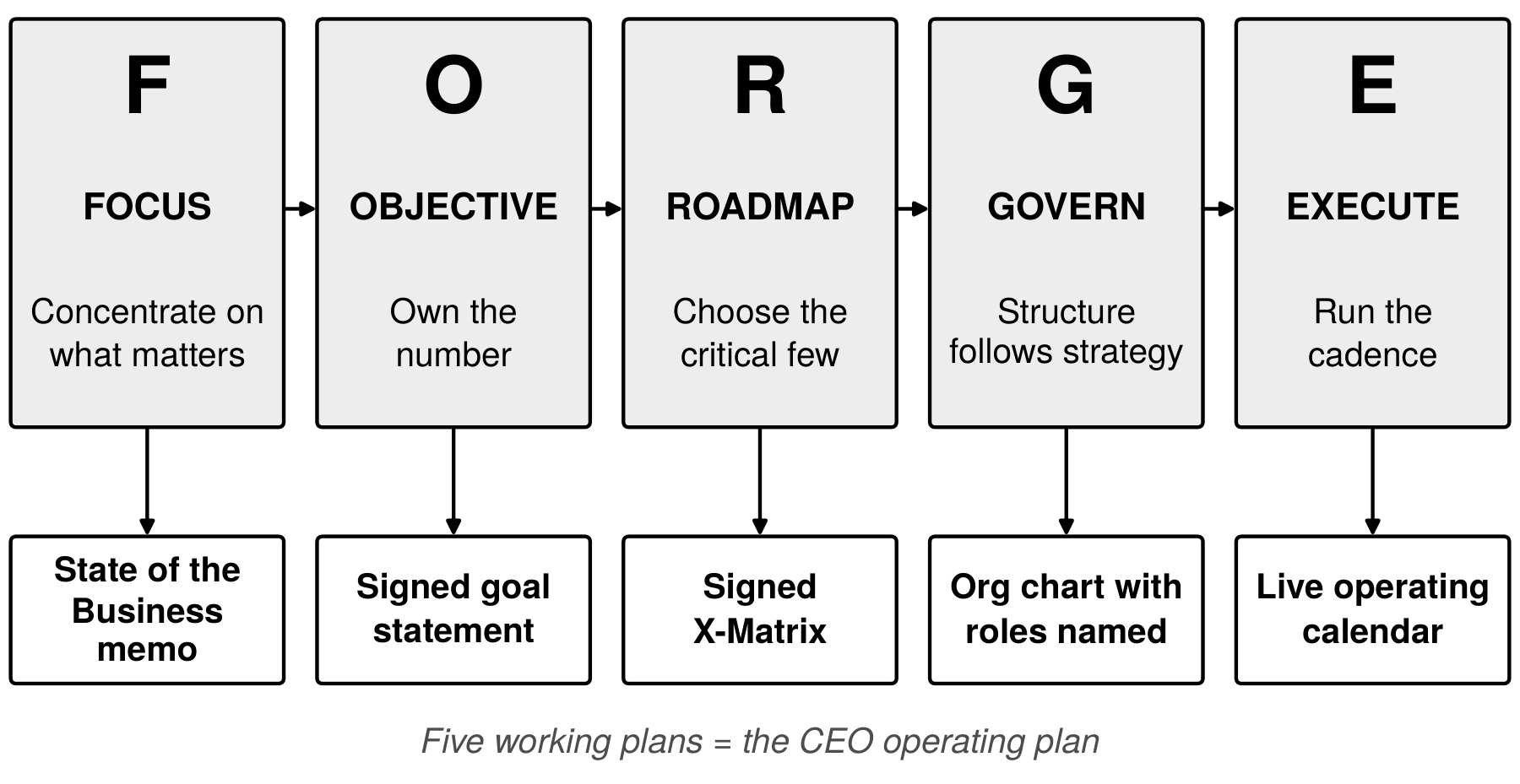
Together, the five working plans are the CEO operating plan: the document you should have had on your first day in the job, and the one almost nobody has.
Harrow
Every discipline in this book is proved on one company, followed from its Day Zero to its first monthly review. Harrow is a composite (the front of the book explains how it was built), but its numbers foot, and the worksheets it filled in are in the Field Guide.
Harrow Motion Components builds and sells actuators, couplings and bearing assemblies (linear-motion and power-transmission components) out of two plants, one in Dayton, Ohio, and one in Greenville, South Carolina, with a distribution center behind them. It employs 480 people. Over the trailing twelve months it sold $120.0 million and earned $12.0 million of EBITDA, which is to say earnings before interest, taxes, depreciation and amortization. Ashgrove Partners, a private-equity firm, acquired it on 1 July 2025. Its Board is the Ashgrove deal partner and an independent chair.
Ashgrove placed Dana Whitfield as CEO in early December 2025. Her team: Priya Raman, CFO. Marcus Hale, chief operating officer (COO), eleven years at Harrow. Tom Keller, VP Sales, nineteen years. Ray Okafor, VP Operations across both plants. Jill Soto, VP Engineering, and Anne Brody, VP People.
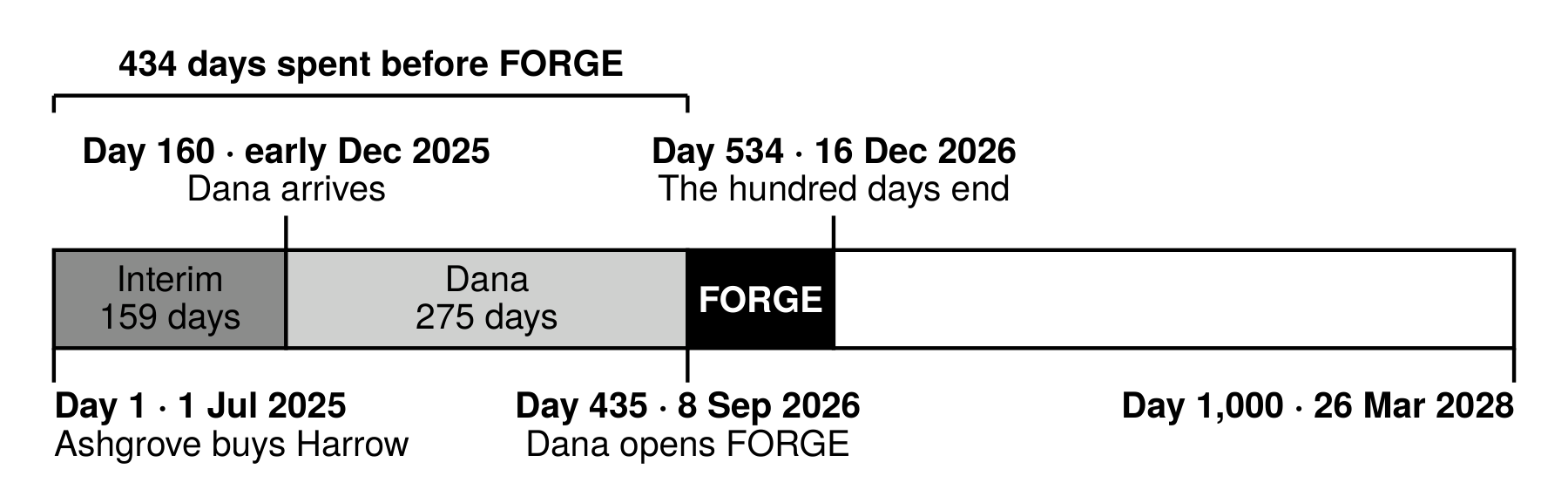
On Tuesday 8 September 2026, about nine months into the job, Dana opened FORGE. She began with the dates.
The clock had started on 1 July 2025, the day the acquisition closed: Day 1. It would end on 26 March 2028, Day 1,000, because the sponsor’s model assumed a sale process would open in the spring of 2028. Her next outside date — the first day on which somebody beyond the building expected something of her — was 21 October 2026: the third-quarter Board meeting, forty-three days away, with a Board that had started putting the same question to her every time it met.
The fourth question took longer, because she had never done the sum. That Tuesday was Day 435. Of the thousand, 434 were already spent, 159 by the interim team before she arrived, 275 by her. Days remaining, counting the one she was sitting in: 566. Forty-three percent of the clock was gone, and nothing on her desk said what it had bought.
Then she scored the readiness assessment, alone, and got three. Zeros came easily. She knew her top twenty customers by revenue. By profit, she could not name them. No one in the building knew what the smallest thousand accounts cost to serve. Twenty-three initiatives were running. Her Monday staff meeting reviewed what everyone had done and decided nothing, and nobody had ever asked it to decide anything.
Her first attempt at the one-sentence plan ran to forty-one words and needed a semicolon to hold it together. Most of the words the cut is designed to remove were in it. So she cut, and what was left was this:
“Harrow earns $22 million a year by March 2028, from the customers and products we are best at, with a team that runs without me in every meeting.”
Twenty-eight words, and every phrase a choice. Its number was the one she understood the sponsor to want — understood, because she had never seen it written down, which is why the third statement on her assessment scored a zero. “The customers and products we are best at” was a promise she could not yet keep, because she didn’t know which ones they were. Its last clause described a company she was not yet running.
Then the question that separates a plan from a private thought: who could say it back to her today? She wrote no names. Within a month the sentence would carry a number the Board had confirmed in writing and her team had signed. That Tuesday it belonged to her alone.
Her last page was the list of what she did not know. Profit by customer: Priya, by Friday. Cost to serve for the small accounts: Priya again, with the order-line counts from operations, the same Friday. Which of the twenty-three initiatives the Board’s plan depended on: Priya, who would build the inventory. What the Board meant by good, on paper: Dana herself, before the October meeting. Three of the four lines carried the CFO’s name.
It was Day 435, and for the first time somebody at Harrow had written down which day it was.
Do This
- Pull the four dates — clock start, clock end, the next outside date, the days spent and by whom — and write the days remaining as a number.
- Score the readiness assessment alone this week, before anyone else sees it.
- Write your one-sentence plan, then cut every word another company could use.
- List everything you cannot answer, with an owner’s name and a due date on each line.
- Block two hours a week on your calendar for the next hundred days.
- Start with Focus, whatever your score.
Horace was generous. Beginning is not half the work — it is only the part nobody else can do for you.