Chapter 1: The Owner Comes Before the Deal
“If we could first know where we are, and whither we are tending, we could then better judge what to do, and how to do it.”
— Abraham Lincoln, address to the Illinois Republican State Convention, Springfield, Illinois, 16 June 1858
A banker calls on a Thursday afternoon. A competitor you have watched for years is quietly for sale, the founder wants out, and two other buyers are already looking. By Friday morning your leadership team is asking the question every team asks first. What is it worth?
That is the second question. The first is what you want the next five years to produce — for you, for anyone who owns the company with you, and for the company itself. A price can only be judged against a purpose, and a purpose can only be judged once somebody has written it down and signed it.
Skip that step and your strategy gets assembled from whatever happened to be for sale that year. Buying a company is a mechanism, never the objective itself.
Acquisitions are jet fuel — if you get them right. Nothing else you can put in a company gives it as much thrust, and in the wrong airframe, or with the wrong crew, the same fuel burns it down. So this book will not tell you to go slow. Discipline is what lets you go fast, and it starts with a page.
What the Deal Is For
Five years is long enough for a purchase to prove itself and short enough that you can still name the people who will do the work. Ask the five-year question of three parties, in order.
Start with yourself. What job do you want in five years — running the company, chairing it, or gone from it? How much of your own money, sleep and reputation will you put at risk to get there? An owner who wants to step back in three years has no business buying a company that will need her for five.
Then your co-owners. A sibling, a spouse, a partner or an investor holding a share has a view of the next five years, and it is rarely identical to yours. One wants cash someday, while another wants the company to grow for her children. A deal does not settle that difference — it puts a deadline on it, and the argument gets louder, longer and more expensive. Have it while nothing is on the table.
Then the company. What should it be able to do for its best customers in five years that it can’t do today? Hold that question, because it will decide what you buy, if you buy anything at all.
The answer has to fit in a sentence with a number and a year in it. Most owners write that number in EBITDA, whose letters unpack to earnings before interest, taxes, depreciation and amortization — a measure of what the operation throws off before the bank, the tax collector and the wear on equipment take their shares. “Grow the company” is a wish. “EBITDA of so much by such a year, with the option to sell after it” is an objective.
Then write the number owners talk about least and care about most: what their stake is worth. Value your own company the way you would value one you were buying — a multiple of its EBITDA, plus its cash, less its debt — and write down what that equity should be worth by the same year. You buy companies to make a ton of money for the people who own yours. Say so on the page, and show the arithmetic.
One Page, Signed
The instrument is a mandate: one page, signed by every owner, that says what the next five years should produce and what the owners will and won’t risk to produce it.
A mandate has four parts.
- The objective. What the company has to produce and what the owners’ stake should be worth, each as a number by a year, and which choices stay open at the end of it — keeping the company, selling it, handing it to the next generation.
- The money limits. A debt ceiling, written as a multiple of EBITDA (2.5 times means no more than $2.50 of debt for every $1.00 of a year’s EBITDA). A cash floor the bank balance never goes below, because EBITDA is not cash. A line on the personal guarantee, the promise to repay the bank from your own house if the company cannot. And a stress test: in the lender’s bad year, the cash available to pay the bank, divided by the interest and principal due that year (the debt service), stays above a stated coverage. At 1.75 times, there is $1.75 of cash for every $1.00 of debt service due that year.
- What must not change. The name on the vans, the town the company is run from, who controls it, the people you have promised to keep. Write only what you would refuse a good price to protect.
- The walk-away rule. The formula that will cap the price of any target, written before any target exists.
Every owner must sign it, because agreement in a meeting is not enough. A signature turns a preference into a limit, and it surfaces the owners’ disagreements while they cost a conversation rather than a deal. A company with one owner still writes the page and hands a copy to someone who will ask about it (an outside director, a spouse, the banker who knows the business).
With the page signed, a banker’s deadline stops being your deadline. Write it before you have a target in mind, though. A mandate drafted with a company already on the table bends to fit that company, and then it isn’t a mandate. It’s a permission slip.
The Walk-Away Rule
Every deal gets more expensive the longer you work on it — in pride first, and then in price. By the third month your team has spent nights in the data room (the seller’s online library of documents), your advisers have sent invoices, and you have told your managers what is coming. Each of those makes the next dollar easier to agree to. The number that would have looked absurd in January looks reasonable in July, and nothing about the target has changed. You have.
I call the defense the walk-away rule. Military pilots fly with the same idea and call it bingo fuel: the fuel state, worked out on the ground before takeoff, at which the aircraft turns for home no matter what is happening in the air. Knowing that number is what lets the pilot fly hard until he reaches it.
The rule is a formula, not a price, and it goes into the mandate before there is a target to apply it to. It has two parts.
- Pay for what the target earns on its own. Start with its normalized earnings, the EBITDA your quality-of-earnings review supports. That review (the QoE) is an accounting firm’s test of which earnings are real and will recur once the seller’s adjustments are stripped out. Then pick the multiple you would pay for that business if you never improved a thing. Corrigan’s mandate says 7.5 times.
- Pay for a stated slice of your own improvements, at the same multiple. The improvements are what your people will do once the deal closes (is legally complete, with the money wired): better prices, work you stop sending out, overhead you combine. The seller did not do that work and won’t be there to do it, so Corrigan’s mandate pays him for a quarter of it at most.
Run it with Corrigan’s numbers. Every $1.00 a target earns on its own is worth up to $7.50 to Corrigan. Every $1.00 of improvement that Corrigan’s own people would have to deliver is also worth $7.50 at that multiple, and the seller may be paid for a quarter of it, which is about $1.88. The other three-quarters stays with the people who will do the work, which is exactly where we want it.
Keep the rule apart from the number it produces. The rule is written once, in the mandate. The walk-away number is the rule applied to one company — dated, signed and shown to the people who would notice it moving. You set it before you sign a letter of intent (LOI), the written offer that usually buys a period of exclusive negotiation. The rule is how bingo is figured. The number is the bingo for one flight.
Set the Posture
Companies drift into deals: a banker calls, a competitor’s founder mentions retirement at a trade show, a manager’s college roommate owns a shop two states over. Each call is easier to take than to refuse — and six months later the company is in a data room it never decided to enter.
It happens more often than you’d think. In a 2017 survey of middle-market companies, those with $10 million to $1 billion of revenue, 21 percent of recent buyers said their deal answered an unexpected opportunity that came their way, not one they went looking for. Some of those deals work out. But the decision to be in the market was made by whoever called.
I call the answer the posture: Active, Passive or Off, written on the mandate with the conditions that move it. It works like a warship’s readiness condition, which one officer sets, everyone aboard knows, and nobody changes without a stated reason.
- Active. You are looking. A target profile (a one-page description of the company you want to buy) is written or has a date, an integration leader is named and her job is covered, the money limits leave room to borrow, and one person owns the search. The integration leader is the person who will run the combining of the two companies once a deal closes.
- Passive. You will answer the phone, but you won’t place a call. The bar sits higher than Active’s, not lower. A company that finds you on its own has found other buyers the same way, and its banker set the calendar and the asking price before you knew it existed.
- Off. No meetings, no data rooms, no “just a look.” The company works on itself. “We’ll see” means Off, so say Off and save everyone the meetings.
Write the conditions in both directions. What would have to be true for Off to become Active? What drops Active back to Passive — an integration leader swallowed by the last deal, margins slipping at home, cash drifting toward the floor? Then write who holds the pen. One person moves the posture, usually the CEO, and only when the written conditions are met. The owners agreed to those conditions when they signed the page, so a move takes no meeting.
Active is for owners who want the company to change — its size, its map, the work it can do — and want it soon. An owner who wants next year to look like this one should stay Off, and I have no quarrel with that. I would rather see a company sit at Off for two years and fix its own prices than go Active with nobody free to integrate what it buys. Active without a named integration leader isn’t Active at all. It’s a mailing address for bankers’ books.
Corrigan
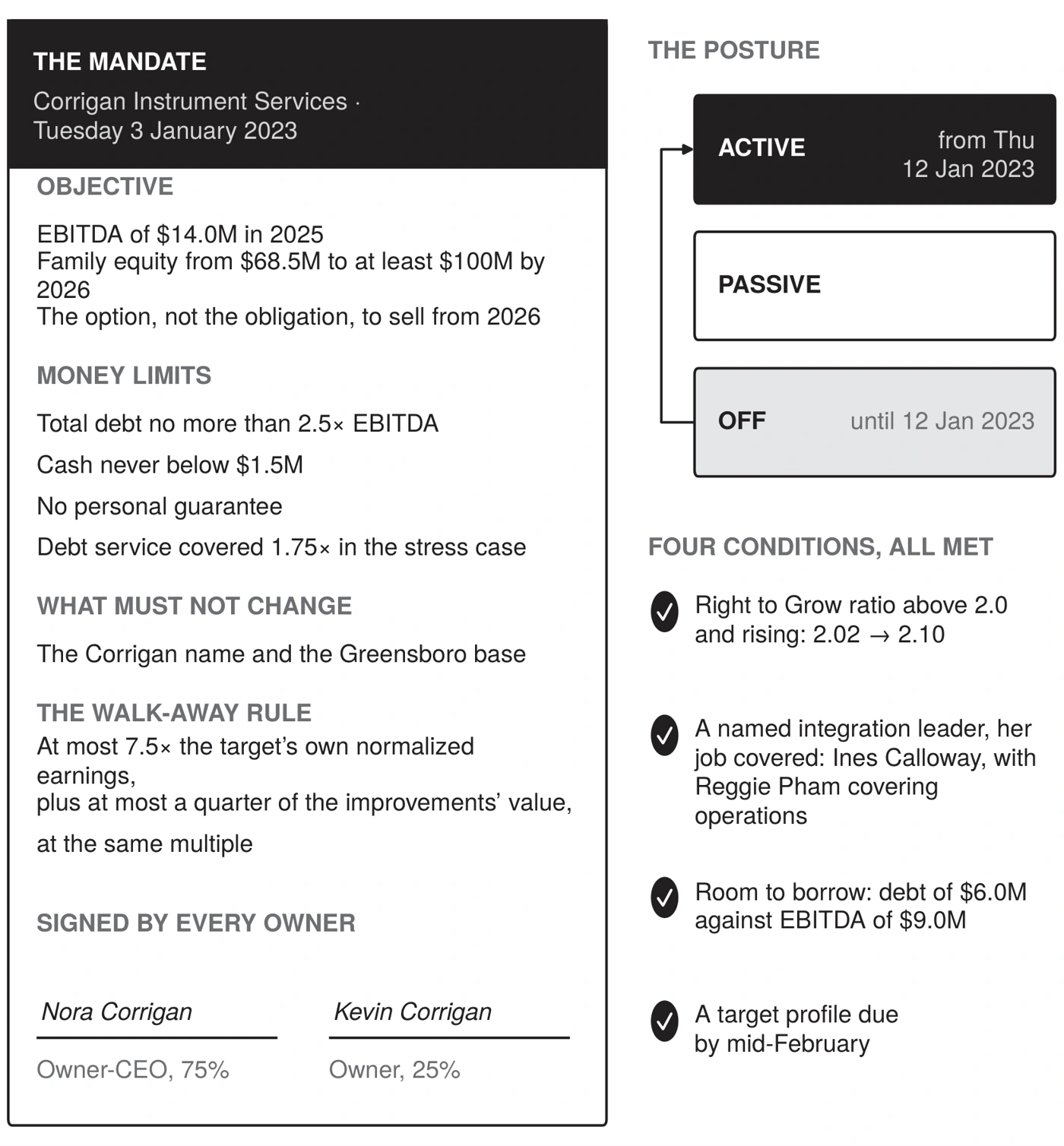
On Tuesday 3 January 2023, Nora Corrigan wrote her company’s mandate on one page. She was fifty-two and the second generation to run Corrigan Instrument Services, the Greensboro, North Carolina, calibration company her father had founded in 1981. It had closed 2022 with $62.0 million of revenue and EBITDA of $9.0 million.
The objective came first: EBITDA of $14.0 million in 2025, the family’s equity grown from about $68.5 million to at least $100 million by 2026, and the option — not the obligation — to sell from 2026. Nora valued her own company at the multiple she would pay for anyone else’s: 7.5 times $9.0 million of EBITDA is $67.5 million, and $1.0 million of net cash (the $7.0 million in the bank less $6.0 million of debt) makes $68.5 million.
The money limits followed. Total debt would stay at or below 2.5 times EBITDA, and cash would never fall below $1.5 million. Neither owner would sign a personal guarantee. Any financing had to cover its debt service 1.75 times in the bank’s stress case, not in Corrigan’s own. Two things could not change: the Corrigan name, and Greensboro as its base. Last came the walk-away rule: no more than 7.5 times a target’s own normalized earnings, plus no more than a quarter of the value of Corrigan’s improvements at the same multiple.
Her brother Kevin owned the other 25 percent. He taught high-school history in Raleigh and had never worked in the business. He wanted two things, and he said them plainly at her kitchen table that evening. “I’d like to be paid for my share someday. I’m not signing anything at the bank.” Two lines on the page already answered him: the option to sell from 2026, and no personal guarantee. He signed.
On Thursday 12 January, Nora moved the posture from Off to Active. The page listed four conditions. The first was the Right to Grow ratio, the margin left after materials divided by the cost of every person on the payroll. It had to be above 2.0 and rising, and it had gone from 2.02 in 2021 to 2.10 in 2022. The second was an integration leader with her job covered. Ines Calloway, vice president of operations, took the role that day, and her deputy, Reggie Pham, took her operations job. The third was room to borrow inside the mandate. Corrigan owed just $6.0 million against $9.0 million of EBITDA, debt of 0.67 times EBITDA against a ceiling of 2.5. The fourth was a date: a target profile, written by mid-February.
Nora held the pen, and with both signatures already on the conditions, the move took no meeting. Figure 01-01 shows the page as it stood that Thursday.
A Seller Needs One Too
The posture covers selling too. An owner who has not written what she wants from a sale is not ready to hear an offer, because the first number she hears becomes her only term. Russ Haskett, whose company Corrigan would buy, founded Haskett Metrology in Marietta, Georgia, in 1992, and by 2023 he was sixty-seven and ready to stop. He had never written down who would run the company after him, what would become of its 118 people or how long he would stay. When he hired a banker on Thursday 11 May 2023, he had one term, a price, and the first price he heard came from his own banker. Part Four is Corrigan’s own sale, and there Nora and Kevin write their terms before any banker says a number.
Do This
- Write your mandate on one page this month — the objective in EBITDA and in owners’ equity, the money limits, what must not change and the walk-away rule.
- Get every owner’s signature on it before you return any banker’s call.
- Write the walk-away rule as a formula — a multiple of normalized earnings plus a stated share of your improvements — never as a price.
- Write your posture, the conditions that move it up or down, and who holds the pen.
- Name your integration leader and the deputy who will take her job before the posture says Active.
A deal arrives with a deadline, advisers and momentum of its own. Write the page first. Bingo is worked out on the ground.