Chapter 1 — The Execution Gap
“Lord Raglan wishes the cavalry to advance rapidly to the front, follow the enemy and try to prevent the enemy carrying away the guns. Troop Horse Artillery may accompany. French cavalry is on your left. Immediate.”
— Lord Raglan’s fourth order at Balaclava, written by General Richard Airey and carried by Captain Louis Nolan (October 25, 1854)
On the morning of October 25, 1854, Lord Raglan sat his horse on the Sapouné Heights above Balaclava, some six hundred feet over the plain, and could see the whole field. Below him lay two valleys divided by a low ridge, the Causeway Heights. Along that ridge stood a line of earthwork redoubts the Russians had taken earlier that morning, and through his glass Raglan watched Russian teams hitching up the British naval guns the redoubts had held, to drag them away. He wanted the guns back. He dictated an order to General Airey, who wrote it in pencil on a scrap of paper, and Captain Nolan, the best horseman on the staff, took it down the escarpment to Lord Lucan, who commanded the cavalry on the valley floor.
Lucan read it twice and could not make it mean anything. From the ridge the captured guns were plain. From the floor of the valley the Causeway Heights showed nothing but their crest, and the only guns Lucan could see were a Russian battery something over a mile away, at the far end of the North Valley, with more guns on the heights to either side of it. “Attack, sir? Attack what? What guns, sir?” he asked — as he later told it — and Nolan, who had come down from the height and thought the answer obvious, flung out his arm toward the end of the valley: “There, my lord, is your enemy. There are your guns.” Lord Cardigan took the Light Brigade down the North Valley at a trot, then a gallop, under fire from three sides, into the battery and through it. Roughly 670 men rode. Something over a hundred were killed and more than half the horses were lost. The whole thing took about twenty minutes. Nolan died in the first minute, riding across the front of the brigade with his arm raised, as if to turn it. The order was right from where it was written and wrong from where it was received, and nothing between the two could ask a question.
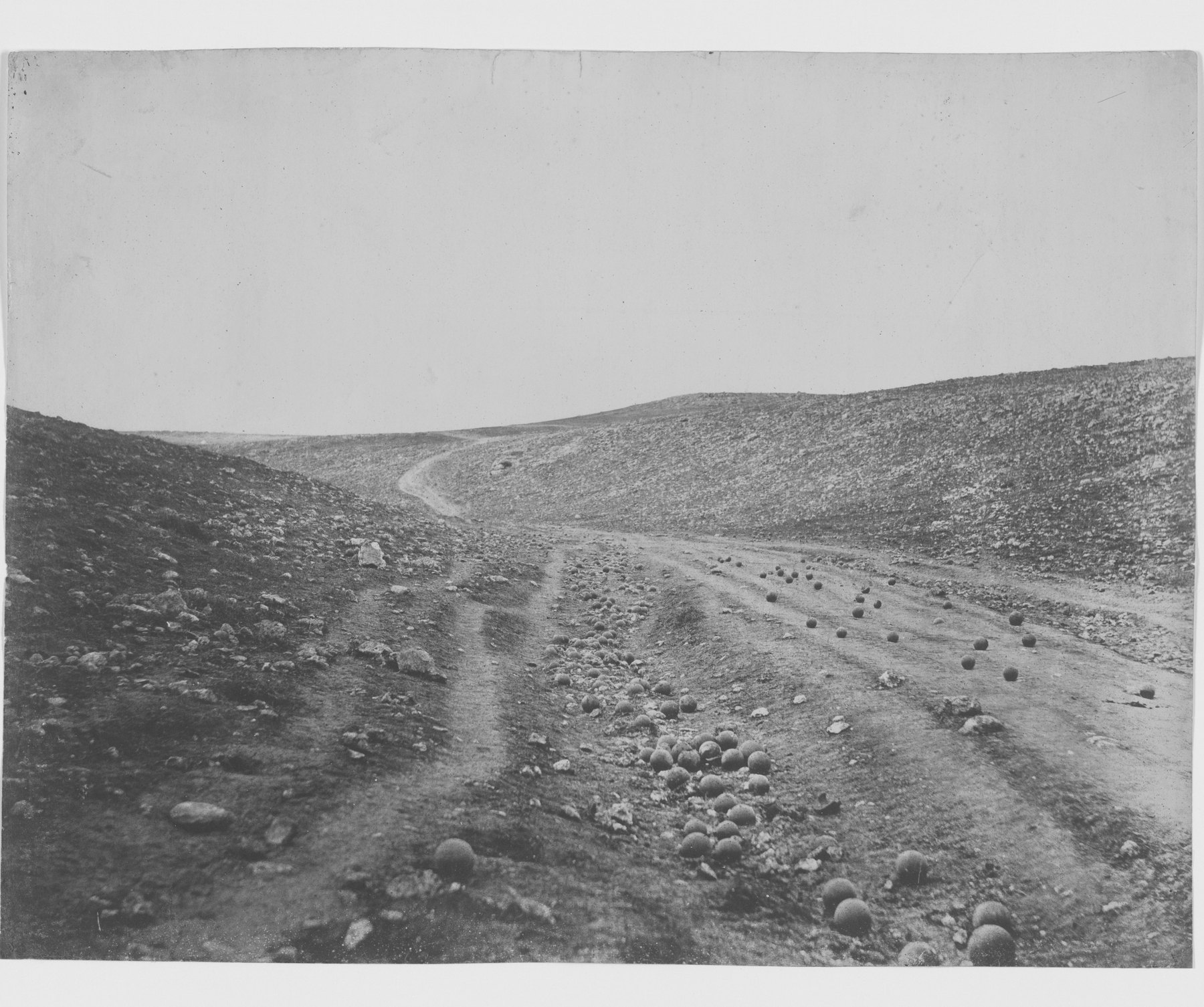
Every plan is written from a height. Your board signs it in December from where a board sits: the sponsor’s model, three years out, the bridge from this year’s number to the one that was underwritten. The people who have to run it receive it on the valley floor, in a plant in Indiana in February, where the view is this week’s schedule, a press that is down again, and a chain that wants its doors by the ninth. The plan says the guns. It does not say which. And in most companies there is nothing between the ridge and the floor that can ride back up and ask.
I’ve watched good plans lose whole years that way, and I’ve lost one or two myself. The one I want to walk you through belongs to Tamarack Cold Systems, the company whose deployment year is the spine of this book, and it happened the year before that deployment began.
A Good Plan in a Drawer
Tamarack builds commercial refrigeration — display cases in Wausau, Wisconsin, walk-in panels and doors in Elkhart, Indiana, condensing units and compressor racks in Sioux Falls, South Dakota — and sells it to supermarket and convenience-store chains, to refrigeration dealers and contractors, and to foodservice-equipment distributors, with a parts-and-service business behind all of it. About 1,100 people. A private-equity sponsor had bought the company, and the year I’m about to describe was its first full year under the new owners. I didn’t run it. The sponsor hired me as CEO on Monday, September 8 of that year, once the miss was certain, and my first monthly management meeting was the September review. I’ll call it Year 0, because the deployment year that follows is Year 1, and because Tamarack still calls it the lost year.
The plan for Year 0 was a good plan. I want to say that plainly, because a plan that fails is easy to remember as a bad one. It had a goal in dollars: $24.0 million of EBITDA, the letters standing for earnings before interest, taxes, depreciation and amortization, which is the line a sponsor underwrites, on revenue of about $190 million, against the $20.1 million the company had earned the year before. It had a story for how: warranty cost was too high, material cost was too high, the dealer channel was leaking price on every quote, and the national chains were buying less from Tamarack than its position on their specifications said they should. Every one of those was true. Every one of them is on the page the same team built twelve months later. The board signed it in December, the leadership team presented it at a town hall in January, and somebody printed it, bound it, and put it in a drawer.
Here is what the year did. Revenue grew about five percent, from $181.0 million to $190.0 million. EBITDA grew $800,000, from $20.1 million to $20.9 million. The margin did not move: 11.1 percent one year, 11.0 percent the next. Against the plan the miss was $3.1 million. Against the sponsor’s case it was worse, because the case needed $34.0 million of EBITDA three years out — the Board’s number, as Take Control calls it, the one the Four Meetings exist to turn into a plan — and a miss at the start of a climb moves the whole climb. From $24.0 million, the distance to $34.0 million is $10.0 million. From $20.9 million it is $13.1 million. The lost year did not cost $3.1 million once: it added $3.1 million to a climb that had three years to finish.
Was Year 0 a bad year? No. Tamarack grew. The sponsor was disappointed, not alarmed. And the people in the room were the same people who, one year later, delivered $25.1 million against a plan of $25.0 million. Nadia Ferreira closed the books both years, Marisol Vega ran the plants both years, and Dev Anand sold to the chains both years. A lost year is a year that came in short of its own plan. This one was run by good people inside a system that gave them no way to do better. The system had five parts, and you’ll recognize every one of them.
The Anatomy of a Lost Year
The first part is that the plan was announced. It was presented at the January town hall in Wausau (four slides, a good speech, the two other plants on video, applause) and that was the deployment. Nobody asked anyone below the leadership team to build a page of it. Lou Petrakis, who ran Elkhart, could have told you in January what the company’s EBITDA goal was. He couldn’t have told you what Elkhart’s yield had to be in June for the company to reach it, because nobody had worked that out, and nobody had asked him what it would take. An announced plan travels down. It does not come back up. So the only people who ever argued with it were the people who wrote it, and they had argued on the ridge, where everything looks possible. If your plan went out the same way (a town hall, a deck, applause) your plant managers are where Lou was, and they won’t tell you so.
The second part is the count. Twenty-three initiatives were in flight during Year 0. I know because I made the list, from the deck, the minutes, and the spreadsheet where they were tracked. Nine had a named owner. Four had a number: a from, a to, and a date. The rest were verbs: improve warranty performance, strengthen the dealer channel, evaluate an e-commerce portal for dealers, reduce complexity in sheet metal. A warranty task force met every other Thursday for the whole year with no number in front of it, and warranty cost finished the year at 2.6 percent of sales. Twenty-three initiatives across eight leaders is nearly three each, before anyone runs a plant or closes a month. Give a leader five and you have chosen, without saying so, which three won’t happen. That is arithmetic, not a judgment on the leader, and in Year 0 nobody did it. At your size the count will differ. The ratio will not. I haven’t yet walked into a company with fewer than twenty things in flight, or one where more than a handful of them had a number.
The third part is when the number arrived. Tamarack closed its books on the twelfth working day, and Jules Achterberg’s FP&A team (financial planning and analysis, the people who turn a close into a deck) built the pack the week after that. The monthly management meeting fell wherever the calendar had a three-and-a-half-hour hole, usually in the last week of the month and sometimes in the first week of the next. So January’s number reached the room three to five weeks after January ended. By then February was gone too, and whatever had slipped in January could not be put right in a month already over. Find out when your own January reaches you. It’s later than you think. The number was also measured against a line nobody had phased. The plan was $24.0 million, so the plan was $2.0 million a month, twelve times, because a budget divided by twelve is the easiest spreadsheet in the world. Tamarack’s year is not flat. The chains remodel in spring and summer, the dealers stock ahead of the season, and the fourth quarter is thin. A flat line against a seasonal business reads ahead when the business is naturally strong and behind when it is naturally weak. It says nothing at all about whether the initiatives are working. That was convenient, because the initiatives had no monthly number to check. They had a spreadsheet with a tab for each and a status column that said green, yellow, or “in progress.” The score was kept after the fact, on a line that meant nothing, for a set of initiatives that mostly had no score.
The fourth part is the meeting. Twenty-one people: the leadership team, the three plant managers, purchasing, both national account managers, all six regional dealer managers, and anyone who had a slide that month. About sixty slides and three and a half hours. Everyone presented. Freight moved three times that year and tariffs twice, and each move got a slide: accurate, complete, and with nothing attached that anyone had to do. Hal Brenner, who ran the Wausau plant then, told me later that he spent two days a month preparing for it. He was asked, on average, one question. I went through the minutes of all twelve meetings and counted the decisions, using the most generous definition I could: anything that named a person, an action, and a date. There were four. Two were capital approvals that could have gone by email. One changed the format of the deck. The fourth moved the August meeting for a board visit. Twelve meetings, forty-two hours, twenty-one people, four decisions. Ouch! A meeting in which everyone reports and nobody decides is not a management meeting. It is a recital, and the audience is the CEO. I’ve run that meeting myself, at more than one company, before I learned better. It is the most comfortable meeting in business. Nothing in it can go wrong, because nothing in it is at stake. Count the decisions in your own minutes, using my definition. It won’t take long.
The fifth part is the quiet one, and it is the one that makes a lost year lost.
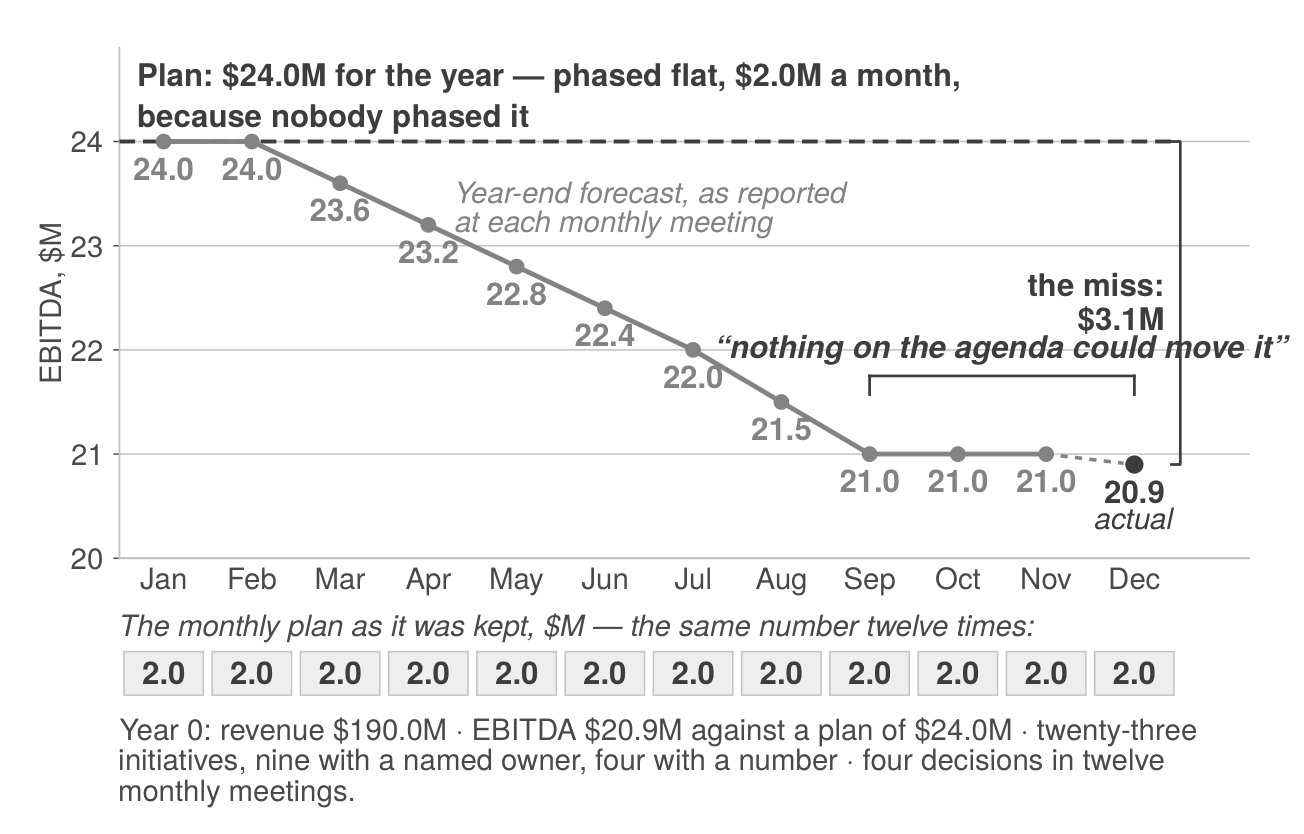
The forecast held at $24.0 million through the February meeting. In March it was $23.6 million. Then $23.2 million, $22.8 million, $22.4 million, $22.0 million: $400,000 a month for five months, each with an explanation that was true. A chain program slipped a quarter, a gasket lot failed at final test, a dealer region discounted its way to its volume number. August took it to $21.5 million and September to $21.0 million. “Twenty-one,” Nadia Ferreira said at the September review, my first as CEO, “and I don’t expect it to move.” She was right. October and November said $21.0 million. The year closed at $20.9 million. Her forecast had been accurate to within a rounding error three months before the year ended, and that accuracy was the problem, because from September on the meeting was not managing a year. It was watching one. You’ll recognize the moment in your own company. It’s the month your CFO stops hedging the forecast and starts defending it. The plan said $2.0 million a month. Reality had said something else since March, and nothing anyone did in that room changed what reality said. When strategy diverges from reality, reality wins. At Tamarack it won in September, and the last three meetings of the year went ahead anyway.
None of that is a people problem. The leadership team of Year 0 did everything the system asked of it. They presented on time, explained accurately, and forecast so well that the forecast came true. The system asked for the wrong things.
The Mirror Image
The remedy is the anatomy turned inside out, part for part. The plan is deployed instead of announced: one page per leader, built by that leader, argued over, and signed back up the chain, so that the plant manager in Elkhart knows in January what June has to look like and has said, in writing, what it will take. There are three to five initiatives instead of twenty-three, each with one name on it and two or three numbers under it. The score is kept month by month on a line that follows the business, not the calendar. The data is in by the fifth business day of the month. So January’s number is in the room in the third week of February, with ten months still in front of it. The meeting fits in an hour, because what is on plan is not discussed. It ends in decisions with an owner and a date on every one. A rule written in January says what a miss means and what has to happen within five working days of it. And the owner writes the forecast and has to defend it every month, so that it cannot settle quietly while everyone watches. That is policy deployment. It isn’t my invention and it isn’t new, and the rest of this book is how I run it.
Before the system, one piece of arithmetic, because you can do it tonight, and because the number, once written down, is what makes a CEO willing to run the system at all.
I call the thing Tamarack lost the execution gap. It is the distance between the plan on the wall and the number on the page, and it is measured not in dollars but in months. The months in which the two were known to disagree and nothing was done about it. Three numbers give it to you. First, the dollars: plan EBITDA minus the current forecast. At Tamarack in September that was $24.0 million less $21.0 million, or $3.0 million. Second, the date the forecast stopped moving: the month in which the year became a result while the calendar still said it was a year. At Tamarack, September. Third, and this is the one to write down, the months of un-acted-on variance: count from the first meeting at which the forecast fell to the meeting at which it settled. March to September is seven meetings. Seven times the number was short, seven times the shortfall was explained, correctly, and seven times the next meeting’s number was lower. Every one of those meetings was a chance (one of the eleven the Introduction counted) and every one was spent on the explanation. A gap of one month is an operating problem. A gap of seven is a lost year. Close the gap in months and you get the dollars back one countermeasure at a time, because a $400,000 shortfall found in March has nine months of correction in front of it, and the same shortfall found in September has one quarter, most of it already booked. One caution. Don’t run this as an accounting test. The dollar figure is easy, and your CFO already has it. The hard number is the honest date, the month you knew and did nothing, and the only person who can put that date on paper is you.
And at your size? If your year is $60 million instead of $190 million, divide the dollars by three. The months do not divide. A forecast that settles in September has settled in September at any size, and a meeting that produces four decisions a year produces four at any size.
Do This
- Compute your execution gap tonight: plan EBITDA minus the current forecast, and the month the forecast stopped moving.
- List every initiative in flight on one page, and strike each one that lacks a single named owner and a from-to number.
- Time your next monthly meeting and count the decisions in it (a person, an action, and a date) before you leave the room.
- Ask each leader, separately and this week, to write the company’s top three objectives from memory, and lay the pages side by side.
- Find the date January’s number will reach you, and write down what you could still do with it on that date.
Tamarack’s plan for Year 0 was a good plan. I have read it. It named the right four problems, put a fair number on the year, and anyone who knew the business would have signed it. It came out of the drawer for the town hall in January and for the board in the spring, and it went back in. The plan was in the drawer the whole year. The drawer was the problem.