Chapter 1 — A Budget Is Not a Strategy
“The sequence is the system.”
— Bill Canady, Take Control (forthcoming)
On July 9, 1941, Franklin Roosevelt sent a short letter to his Secretaries of War and Navy asking for an estimate of “the over-all production requirements required to defeat our potential enemies.” America was not at war. Its Army had about a million and a half men, most of them draftees and Guardsmen whose year of service was about to run out, and the House would vote that August to keep them by a single vote. The letter went down the chain — Stimson to Marshall, Marshall to the War Plans Division — and stopped at the desk of a major named Albert Wedemeyer, whose birthday it was. He had spent two years in the late 1930s as a student at the German war college in Berlin, which is one way to learn how a potential enemy counts.
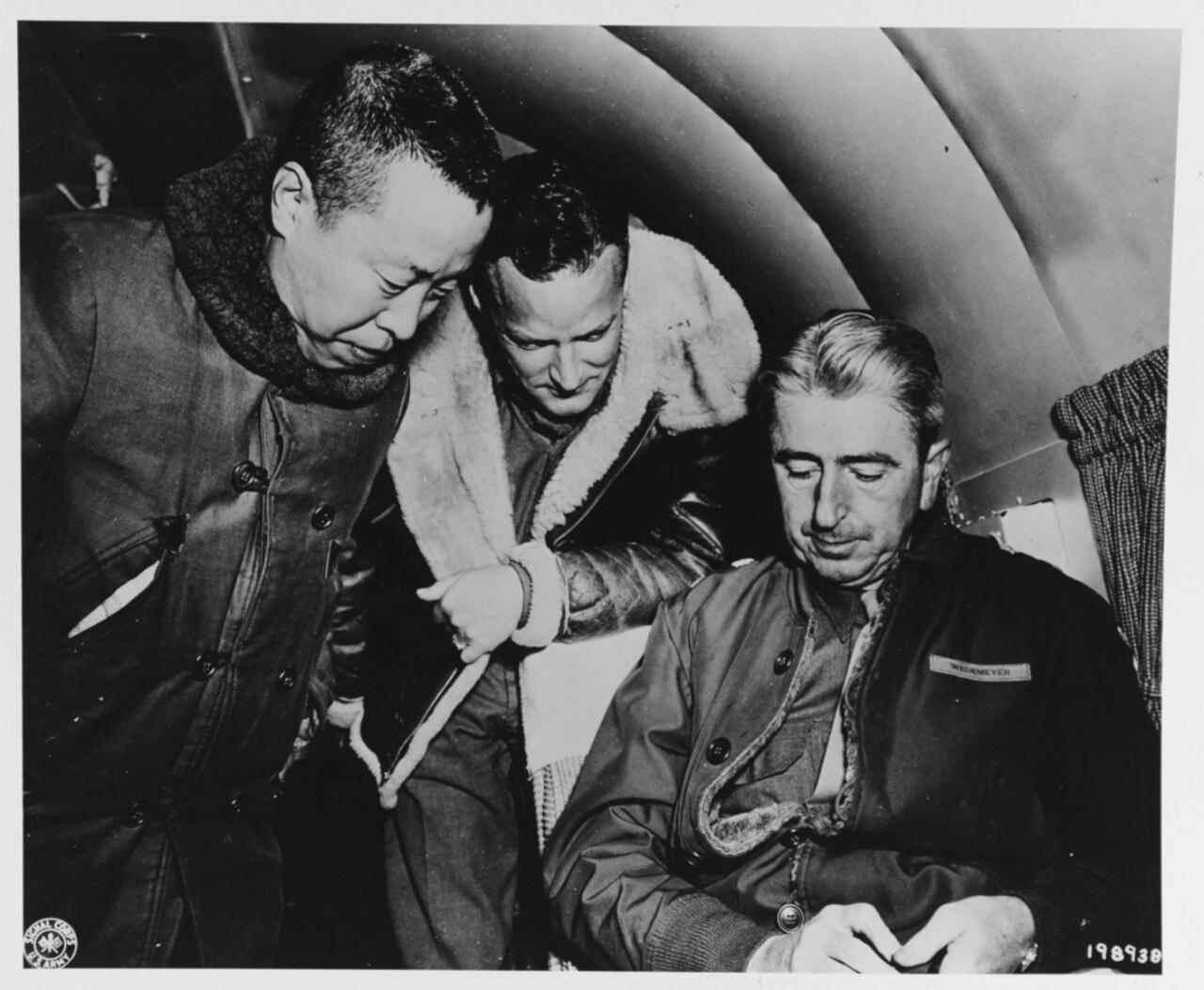
Every department already had a list: the Army wanted more of what it had, the Navy wanted ships, and the air arm wanted anything with wings. Answering the President the easy way meant collecting the lists, adding them up, and sending the total upstairs with a cover memo. Wedemeyer had been told not to do that, and he didn’t. He started at the other end. What would it take to win? Not to hold, not to deter, but to defeat Germany on the ground in Europe. He worked backward from that: the enemy divisions that would have to be beaten, the American divisions needed to beat them, the men to fill the divisions, the ships to carry them, the steel to build the ships, and the date by which all of it had to exist. For the men he began with the population of the country and subtracted (the workers industry could not spare, the farmers, the too old and the too young) until what was left was the army the country could actually field. His first count came to 215 divisions and 8.8 million men, ready by the summer of 1943. Nine weeks after the letter, on September 11, 1941, the Victory Program went to the President.
It was wrong in many of its details. The Army that won the war fielded fewer than a hundred divisions, not 215, because the men went into airplanes, ships and factories instead. It was still the most useful document the War Department produced that year, because of its shape. It started from the number and worked back to the requirement. Wish lists were the one input it did not use.
Most companies build their plan the other way around. That is the first way a plan dies.
Four Ways a Plan Dies
A budget is not a strategy. A budget says how much you will spend, on what, and when. It doesn’t say what you refused, who is on the hook, or what happens in March when the number is short. Most companies have a budget with a growth percentage on the top line and a binder from the last offsite, and they call the two of them together a strategy. It isn’t one. I have run enough of these companies to have the receipts. One of them had grown from $90 million to more than $700 million in sales under two sponsors, and every business it bought had performed worse after the acquisition than before it. That company had a budget every year of its life. It never once ran a strategy to grow the business.
When I got to Ironwood Process Components — a maker of engineered valves, seals and fluid-handling assemblies, five plants, about nine hundred people, owned by a private-equity sponsor — I asked for the list of initiatives and got twenty-seven, of which eleven had a name attached and just three had a number. Twenty-four without a number had a slide.
How do plans die? Four ways, and Ironwood’s had died all four.
Nobody subtracted. Twenty-seven initiatives is a wish list, not a strategy. Every function’s project made the binder because leaving it out would have meant an argument, and offsites are built for agreement. Divide twenty-seven by eight leaders and you get more than three apiece, on top of the jobs they already had. Nothing was chosen, so nothing was strategic.
Nobody owned. Eleven initiatives had a name. Sixteen belonged to “the team,” and the team was busy. When a thing belongs to everyone, the calendar decides who works on it, and the calendar always has other plans. The eleven names had been assigned, not accepted — nobody had said “mine” in front of anybody. The binder carried one signature, the board’s, and a plan needs two.
Nothing cascaded. The plan lived in the leadership team. The plant manager at Plant 4 had never seen it. The quote desk had never heard of it — and the quote desk was where the price was leaking. A plan the second level cannot recite is a leadership-team plan, and the leadership team does not make the parts.
Nothing kept it alive. There was no rhythm, no meeting whose only business was the plan against the actuals. The binder was reviewed at the next offsite, by which time it was a different year and a different binder.
Four causes, one disease. Ironwood’s plan had been built to be presented, and nothing about it had been built to be run.
Six Cylinders, One Order
You don’t cure this with a better offsite. You cure it with a process, and I mean process in the plain sense. What is a process? A fixed set of steps in a fixed order that produces the same kind of output every time it runs. I call it the Strategy Management Process. I didn’t invent it. Operators were running versions of it before I ran anything, and I inherited most of what follows, changed what didn’t work, and kept running it until I had the receipts.
Think of it as an engine with six cylinders that fire in a fixed order. Each cylinder does one job, produces one thing, and hands the crank to the next. Run them in order and the engine turns. Run them out of order, plan before you assess, deploy before you plan, and the engine does not run rough. It does not run.
The six, in order:
Situation Assessment. What is actually true about the business, on the evidence, before anyone proposes anything — the year decomposed, the strengths tested, the market read, the organization judged. It produces the Situation Assessment Summary: no more than seven insights a board member can read in ten minutes.
Framework. Every candidate initiative collected in one format, tested against three futures, ranked on what it is worth and whether you can do it, and the line drawn — the few funded, the rest deferred or declined, on the record. It produces the Funded Initiative Portfolio.
Business Plan. The strategy in numbers the board will hold you to: the top-down, the bottom-up, the gap between them closed with decisions, the organization loaded and checked, and the budget locked. It produces the One-Page Plan and the Locked Budget.
Deployment. Three-year objectives to annual goals, annual goals to the targets that lead them, targets to names — on one page. It produces the X-Matrix, which is not a poster. It is a test.
Cadence. The monthly plan values, the thresholds set in advance, the root-cause discipline when a month goes red, the Monthly Business Review — the MBR — designed to discuss only what is off plan, and the cascade that carries the plan to the people who make the parts. It produces the Bowler Pack and the MBR calendar.
Boardroom. The plan assembled in an order a director can trace, the narrative in five moves, the two or three decisions that are genuinely the board’s, the twenty questions you least want to be asked, and the rehearsal. It produces the Board-Ready Annual Strategy Plan, and the board signs it.
Two of the six come as a pair (the page and the budget locked under it, the pack and the calendar it runs on), and each pair counts as one artifact, because neither half is any use without the other.
Run in order, the six produce three things: a plan the team has signed, a plan the board will sign (the same plan, in that order), and the system that runs it month by month until the next one. That is the whole promise, and it is enough.
One caution. A process is not a substitute for a decision, because the engine turns the crank and does not steer. There is a point in every phase where the process hands you two defensible answers and waits, and it cannot decide for you. Thinking is required.
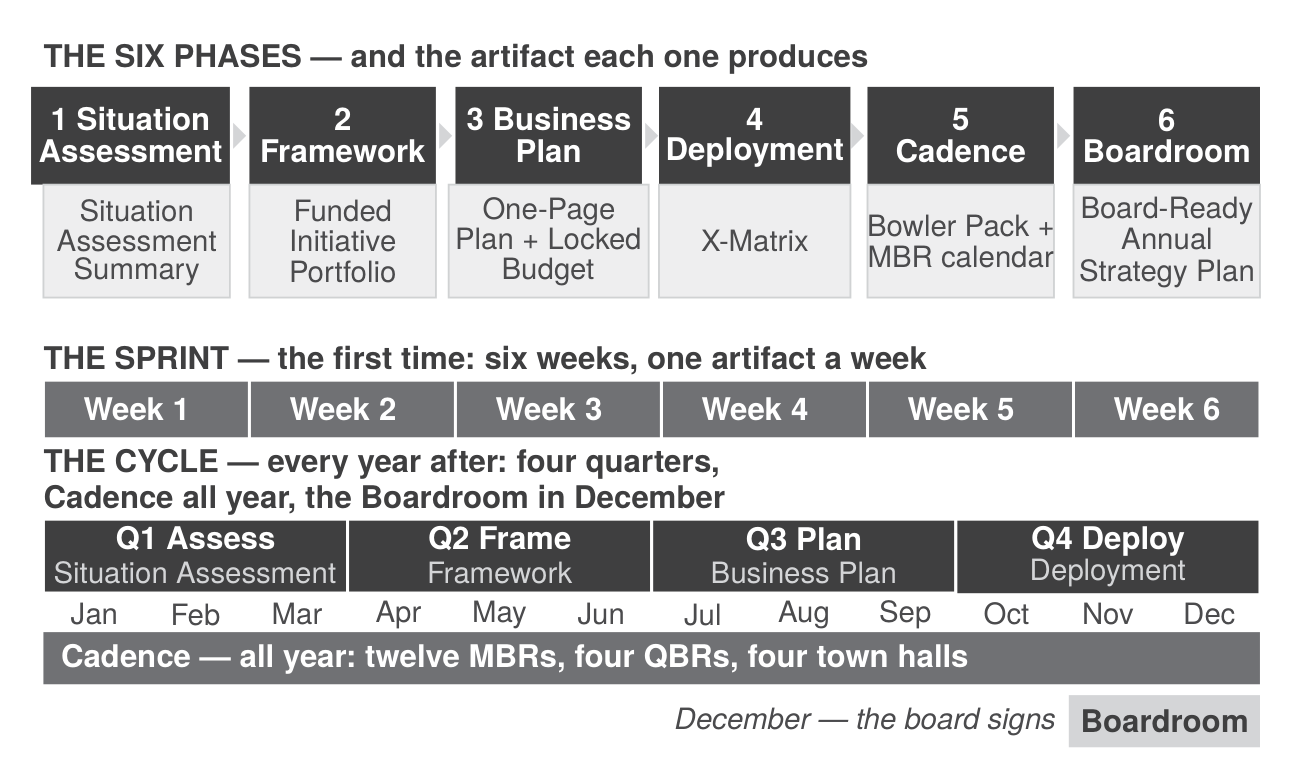
You run the six phases at two speeds. First time through, you run them in six weeks — one phase a week, one artifact a week, two workshops that need all eight leaders in one room — because a leadership team that has never done this must watch the whole engine turn once before it will trust it. That is the Sprint. Then you stretch the same six across the four quarters of every year that follows: assess in the first quarter, frame in the second, plan in the third, deploy in the fourth, with the Cadence running all twelve months and the Boardroom in December. That is the Cycle. Think of the Sprint as training and the Cycle as the job. At the 80/20 Institute we run the six-week version as a program under the same name (a CEO and a handful of leaders, an artifact due every Friday), and this book is the whole of it, so you can run it without us. Six weeks the first time, four quarters every year after. You won’t need a better offsite. You’ll need a calendar.
Who Owns What
Who owns each phase? Not always you. Four roles carry the whole process, and the first thing to get right in Week Zero is who holds which.
You, the CEO, own the number and the decisions. Not the process, not the meetings, not the model. The number, and every decision that changes what the company will do to reach it. That is the whole job, and it is enough to fill one.
The Prophet owns the calendar. In The Rule of Three I gave that name to the leader, usually the chief operating officer, who takes the Visionary’s intent and turns it into something the operators can execute. In this process the Prophet runs the six phases, holds the clock in every meeting, chases every artifact, and owns no initiative of his own, because the person who holds the clock cannot also be on it. At Ironwood that was Ray Okafor, our COO. Ray owned the calendar and nothing else, and there was an argument about that later (Chapter 8).
Your chief financial officer, the CFO, validates every number. Not builds. Validates. Somebody else can build the model, but the CFO is the person who signs the arithmetic, and no figure goes on a page the board will see until she has.
The owners own initiatives. One name per initiative, with the authority to move resources inside it and the duty to report. Three to five of them, never more, and I will spend a whole chapter on why (Chapter 4).
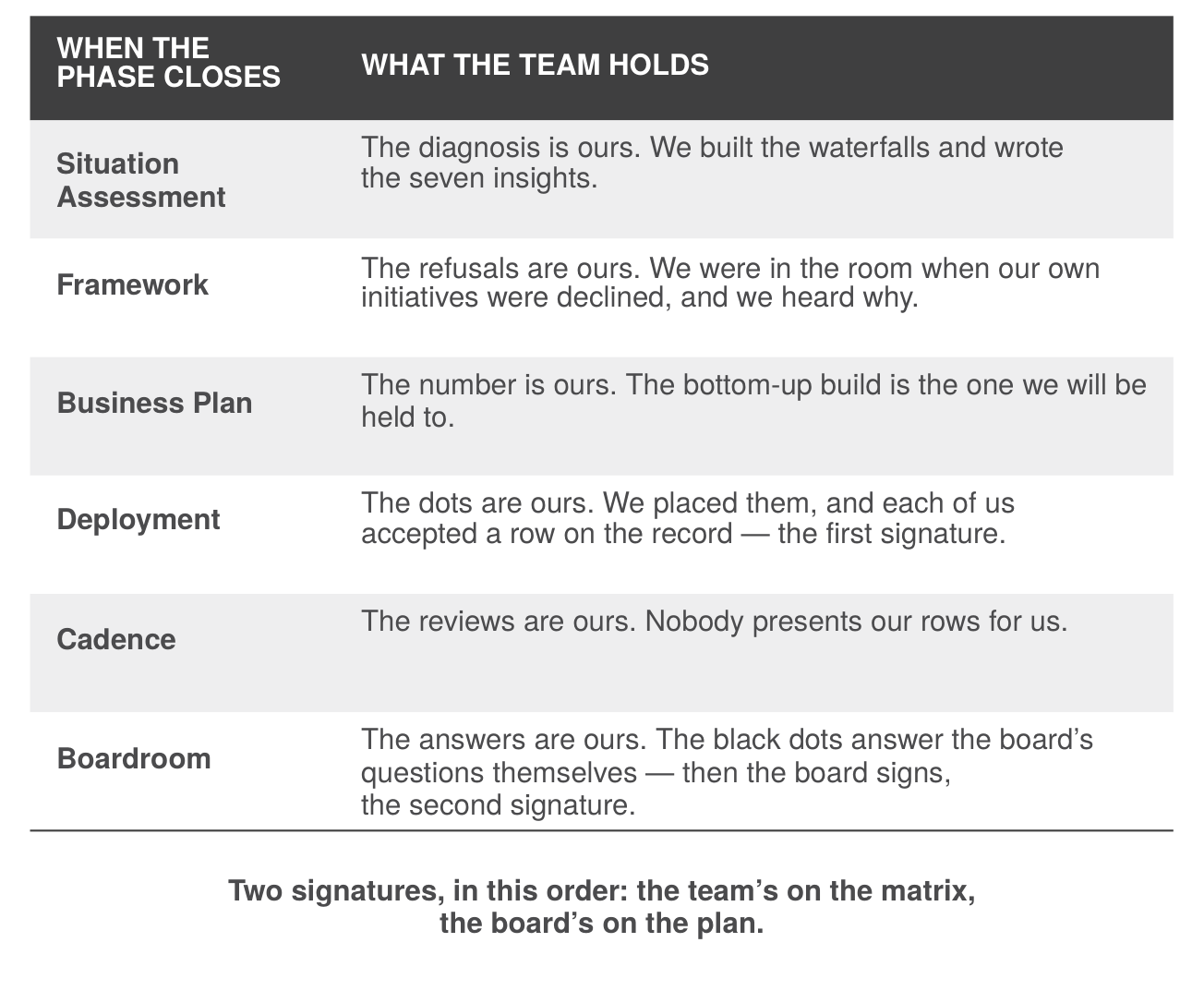
Owning a phase is not the same as owning the plan. Whoever will deliver the plan owns it, and the process manufactures that ownership one phase at a time instead of asking for it at the end: the two signatures of the Introduction, taken in order. Figure 01-02 shows what the team holds when each phase closes. Its dots are the names beside the rows, black for the owner who answers for the row, and Chapter 8 places them. The board’s signature is the last line on it, not the first.
Week Zero
If you ran your first hundred days the way I laid them out in The 80/20 CEO — four steps, in order: a goal, a strategy, a structure, an action plan — you have already run the abbreviated version of this process, and you arrive at Week Zero holding the first thing it asks for. Those four steps get a new CEO from Day 1 to Day 100 with a goal and a direction. This is what you run for the nine hundred days after that, and every year after those.
There is a week before Week One, and most of the failures I have seen in the process were arranged there. Five things happen in Week Zero, and none of them is analysis. None of them is a prerequisite in the literal sense. Skip any one of them and the process still runs. What it produces is a document.
1. The Locked Number. You don’t start the process to find a goal. You start it because you have one. Where does the number come from? One of three places: the sponsor’s underwriting case, the board, or the goal-setting arithmetic in the book I just named. That arithmetic is short. Your sponsor paid a price, expects to sell at a multiple, and promised the people who put up the cash a return on it — a multiple on invested capital, MOIC in the trade. Work that backward through the exit multiple and the debt, and what falls out is the EBITDA, the earnings the business must make before interest, taxes, depreciation and amortization, by the date the sponsor intends to sell. That is the number. It is a number, not a sentence.
At Ironwood it was $40.0 million of EBITDA within three years. We had made $24.2 million last year on $220 million of revenue, 11.0 percent. That left a gap of $15.8 million. Revenue was not the number. Revenue is a consequence, and the plan would eventually put it at $275 million, but nobody had asked for that. They asked for $40.0 million, which meant the margin had to climb from 11.0 to 14.5 percent: most of the $15.8 million would come from price, mix and the aftermarket, not from volume, and Chapter 5 shows it line by line. The sponsor’s model had been rebuilt twice since the closing, once for tariffs on imported castings and once for freight, and the number had not moved, which told me it was a number the sponsor intended to keep. Write yours on one line with the date beside it, and get the chair’s initials on it. Without it the process still runs. It just doesn’t aim.
2. The Core Team. No more than eight people, not counting you, each of whom controls a material part of the profit and loss (the P&L) or the operating model. Eight is not a suggestion. Why? Above eight the room stops arguing and starts presenting, and a room that presents cannot say no. Your first list will have twelve names on it. Everyone’s does. Cut it to eight and tell the four yourself, before they hear it from the calendar. Eight is a ceiling, not a quota. A $30 million company has five people who qualify, and the process runs the same way with five. Ironwood’s counts are the ones in this book, and the rule underneath them is that the room holds only the people who can say “mine” to a number.
At Ironwood the eight were Ellen Voss, our CFO, and Ray Okafor, the COO who would run the process, along with Tom Brandt in sales, Lena Marchetti in operations with five plants under her, and Sam Delgado in engineering. Curtis Nyberg ran Aftermarket & Repair — the business that made 45 percent of our EBITDA and had been treated like a parts counter. Marta Klein ran human resources, and she was there because the plan would change the organization and she would have to build what it changed. The eighth seat went to Priya Raman, our director of FP&A — financial planning and analysis — who controlled no P&L and would build every model the process needed, which in this process is a material part of the operating model. Who was not on it? The general counsel, the head of IT, and the two plant managers who asked. I told them, and I told them why.
3. The one decision. Write down the one decision the plan must inform. Not the purpose. The decision: a capital request, a board approval, a restructure, the annual budget. If you can’t name it, you are about to spend six weeks producing a document, and the document will be good, and nobody will use it. At Ironwood it was one decision with two parts: the sponsor’s Year 1 budget, due in December, with a $6.5 million capital request inside it — two service centers and a scheduling system — that could not go to the board without a plan around it. Every page the process produced was judged against that decision. Any page that didn’t help make it was a page we didn’t need.
4. The input set. Pull it before Week One, into one folder, because a strategy process fails on its inputs long before it fails on its thinking, and it fails quietly, in Week Three, when a number the whole plan rests on turns out to be somebody’s memory. A short list: three years of P&L, balance sheet and cash flow, the credit agreement with its covenant tests, the capital plan, revenue by customer and by product, gross margin by segment, headcount by function, and the current budget. Then the market file: the competitor list with estimated share, pricing benchmarks, and win/loss data. Pull it by hand or let the tools you have pull it from your systems, and tie the totals to the financial statements before anything goes in the folder. Priya had the financial set in four days. Three weeks went on the market file, because nobody had written down why we lost a quote since the company was founded and the win/loss file was Tom’s recollection. We started Week One with what we had and a note on the front of the folder that said so.
5. The Readiness Baseline. The last thing in Week Zero is a question most leadership teams never ask: is this company ready to run a process at all? I call the answer the Readiness Baseline. It is the preflight walkaround, twenty-one items in five dimensions, each scored one to five, before anyone touches the controls. The five dimensions, in plain words: the quality of your data, the discipline of your process, whether the team actually agrees, who owns what, and whether the board is ready to be handed a plan. Twenty-one items at five points each is 105. Nobody scores 105. (If you do, one of your scorers is being kind.)
Mechanics matter more than the score here, and the first of them is that you score it alone. Then two leaders score it blind — separately, without seeing yours or each other’s. Then you lay the three sheets side by side and mark every item where two scores differ by two points or more. Every one of those gaps is a conversation before Week One. Not a negotiation about the score. A conversation about why two people who run the same company see it differently. Those gaps are the diagnostic. The total is just a number.
Ironwood scored 38 of 105. We had data, no process, a team that agreed in the room and disagreed in the hallway, and a board that had stopped expecting a plan. Ellen scored data quality a four: her ledger closed on the fourth business day and tied out. Ray scored it a two: his plant reports came from three systems and agreed with none of them. They were both right, and that was the conversation that put the customer file, not the model, at the top of Priya’s list. It cost just an hour. It would have cost us Week Three.
One more caution, a different one. You can’t fail the Readiness Baseline (nobody fails a walkaround), and a low score is not a reason to wait but the reason to start. But a team that scores itself in the nineties and finds nothing to argue about has told you something too, and what it has told you is that it does not yet know what the process is going to ask of it.
Do This
If you are the CEO: 1. Write the number and the date on one line and get the board chair’s initials on it this week. 2. Name the eight, and tell everyone who is not on the list yourself, before Friday. 3. Write the one decision the plan must inform in one sentence and pin it to the front of the folder. 4. Score the Readiness Baseline alone, then have two leaders score it blind.
If you run the process: 5. Pull the input set — three years of financials including cash flow, the credit agreement and its covenants, the capital plan, revenue by customer and product, margin by segment, headcount by function, the budget, the market file — into one folder by Friday. 6. Lay the three baseline scores side by side and list every gap of two points or more with the two names attached. 7. Block the six weeks on the eight calendars and your own now, the two workshops included.
An engine with six cylinders and no load makes a great deal of noise. I have watched leadership teams run every phase of this process well and produce a binder, because there was nothing on the shaft, no number for the engine to turn against. Your number is the load. Without it the first cylinder fires and nothing moves.
Week Zero is the only week in the process you can skip without anyone noticing, and the only one you can’t afford to.
Get the number. Then earn the right to plan. That is the next chapter.