Chapter 1: Nobody Owns the Price
“That which is everybody’s business is nobody’s business.”
— Izaak Walton, The Compleat Angler (1653)
Pull the last twenty invoices for your best-selling item. Not a summary, not a report from the system — the invoices themselves. Lay them on a table in date order, and beside each one write the name of the person who decided that price.
You won’t be able to finish.
On a few you’ll write the name of a rep. On one or two you’ll write the sales manager who said yes on the phone. Somewhere in the pile is a contract price signed in a year nobody remembers, for a customer who has since doubled in size, or halved. On the rest you’ll write nothing at all, because the price was whatever the system held, and the system held whatever somebody typed into it once. Twenty invoices, perhaps a dozen different prices for the same item, and not one of them a decision you could explain to your Board.
That is the ordinary condition of pricing in a company that has never had a method. Everyone who touches an order touches the price: the rep, the manager, the inside salesperson, the analyst who loaded the file, the buyer who pushed. Izaak Walton was writing about fishing in 1653, and he described your invoice file exactly. When a price belongs to all of them, it belongs to none of them.
When I start work with a company, I ask for those twenty invoices before I ask for a single report. The pile tells me more about how the place is run than the budget does.
Four ways a price gets set
When nobody owns the price, it still gets set. It gets set by accident, in four ordinary ways, and most companies use all four at once.
Habit. Last year’s price, plus a round number — or plus nothing. The list was fully revised in some year everyone treats as the beginning of time, and every change since has been a patch on it. Habit feels safe because nobody complains, and nobody ever complains about a price that is too low.
An old markup. Years ago, somebody decided the company would sell at cost plus a fixed percentage. The trade calls it cost-plus pricing, and it was probably sensible when it was chosen. But a markup knows nothing about what a customer would pay, nothing about the customer’s alternative and nothing about the work it takes to serve that customer. When your costs fall, it hands the saving to the customer automatically. When they rise, it waits for someone to notice.
The competitor’s price, as your own salespeople report it. Have you seen the quote? Usually nobody has. It is a number a buyer mentioned on a call, and the buyer’s job is to get your price down. Your reps aren’t lying to you. They’re passing along the lowest number they heard, because the lowest number is the one buyers repeat.
Whatever it took to close. The order at the end of the quarter. The discount to keep an account that was never going to leave. The trial price that became permanent. Each concession was small and made sense on the day, and none of them expired.
Look at the four together. Which of them is a decision about what the product is worth to the customer? Not one. Each is a decision about something else — continuity, cost, fear, the quarter — and the price is a side effect.
On a real invoice the four are layered on top of each other. A price that began as cost plus a markup in 2016 picked up a special discount in 2019 to match a rumor, skipped the 2022 increase because the rep didn’t want to make the call, and lost a little more to close a quarter-end order in 2024. Who decided that price? All four of them did, and not one of them was a person.
This isn’t a quirk of smaller companies. When Andreas Hinterhuber reviewed about two dozen studies of how companies set prices, in 2008, he found that competitors’ prices carried an average weight of 44 percent and costs 37 percent. Value to the customer, the one thing a price is supposed to capture, carried just 17 percent.
The arithmetic
Why should a CEO care about any of this? Because of what a single point of price does to profit.
A point of price is 1 percent more on what you actually collect, for the same volume. It costs nothing to produce, because you make no more product, ship no more freight and hire nobody, so nearly all of it falls to EBITDA — spelled out, earnings before interest, taxes, depreciation and amortization. Call it operating profit, the number a buyer of your company pays a multiple of.
Let’s start with the rule, because it fits on a napkin: divide one point by your EBITDA margin. If you earn 10 percent EBITDA, one point of price raises EBITDA by 10 percent. If you earn 5 percent, as many distributors do, it raises it by 20 percent. At 15 percent it is about 6.7 percent. If your own margin is 12 percent, one divided by 12 percent is about 8.3, so a point of price would lift your EBITDA by about 8.3 percent — provided it sticks and you lose no volume. That proviso is real, and Step 8 deals with it head-on.
You may have seen one famous number instead. In 1992 Michael Marn and Robert Rosiello of McKinsey studied the average economics of 2,463 companies and found that a 1 percent improvement in price, with no loss of volume, raised operating profit by 11.1 percent. The same improvement in volume raised it by just 3.3 percent. Later McKinsey work gave 8 percent in 2003, from the income statement of an average S&P 1500 company, 8.7 percent in 2014 and 22 percent in 2019, for distributors alone. Do the studies disagree? Not at all. They measured companies with different margins, and each number is simply one divided by the margin of the companies in its sample. Eleven percent is what a 9 percent operating margin produces. So I’d stop quoting anybody’s number and compute your own.
Now we can put price beside the other two ways to earn the same dollar. Take a company with $40 million of revenue and $2 million of EBITDA, a 5 percent margin. Its contribution margin — what is left of each sales dollar after the costs that rise and fall with volume, such as material, freight and commission — is 30 percent. Its overhead, the salaries, rent and systems that don’t change with each order, is $10 million.
- From price. One point is $400,000. That is a fifth of EBITDA, earned on orders the company already has.
- From volume. Each new dollar of sales brings 30 cents of contribution. To earn $400,000, the company needs about $1.33 million of new revenue — 3.3 percent more of everything, sold, made, shipped, invoiced and collected.
- From cost. It cuts $400,000 of overhead, or 4 percent of it, found line by line and usually with people attached.
The first is a decision. The second is a campaign. The third is a sacrifice. All three buy the same dollar, and only one of them is paid for by customers who already buy from you.
Fast, and nothing to buy
How quickly does each one pay? Price is the fastest of the three by a wide margin. A price you decide this month is on next month’s invoices. New volume needs capacity, reps, a market willing to take it and usually a year or more before it pays. Cost programs take quarters to design and quarters more to show up, and they often cut something you later wish you had kept.
Price needs no capital — no plant to build, no company to buy and no pricing software to install before you begin. It needs a decision, an owner and the nerve to hold it. That last part is the catch, because the same speed runs in reverse and a price can leak back out of the invoices as quickly as it went in. Somebody must be watching when it does, which is why the last of the ten steps exists.
Why nobody pulls it
If price is the fastest and cheapest lever a CEO has, why do so few companies pull it on purpose? The same four reasons come up almost everywhere I look.
The first is fear of the loud customer. Every leadership team remembers the account it lost after the last increase, and the buyer who shouted about it, and that one memory sets prices for years. Step 9 tests the memory against the numbers.
The second is pay. Most reps are paid on revenue, so a discount costs the rep a sliver of commission and costs the company a slice of its margin. I don’t blame the reps for this. They are responding exactly as the plan tells them to, and somebody at the top signed the plan.
The third is data. Almost no company can say, without weeks of work, what it is paid for a given item by a given customer after everything it gives away. You can’t manage a number nobody can see.
The fourth is a belief: “The market sets our price.” The market sets a range. Where you sit inside that range is a choice, yours or somebody’s. If the market really set your price, those twenty invoices would all say the same thing. Do they? I have never seen a pile where they did.
The outside evidence agrees. Simon-Kucher’s Global Pricing Study 2025, a survey of more than 2,200 business leaders in twenty-eight countries, found that companies realize on average 43 percent of the price increases they plan. More than half of what they decide never reaches an invoice. And in a 2019 study of the Global Fortune 500, Stephan Liozu found that only about one in five of the world’s largest companies had a dedicated pricing function. Nobody has counted the middle market, but from what I see there, it is rarer still.
Put the four reasons side by side and you can see why so many companies leave price alone. Each is reasonable on its own, and each points at somebody else — the customer, the rep, the system, the market. None of them points at the CEO, which is exactly why the work must start there. And the cost of waiting is not zero. Every month the price sits unowned, that month’s discounts join the ones from every month before, and the next increase has to climb over all of them.
Power and discipline
Two ideas get tangled here, and it helps us to pull them apart before we go further.
Pricing power is the ability to raise a price without losing the customers who matter. It comes from being better than the customer’s alternative in ways the customer will pay for — uptime, speed, a part that fits only your housing, a technician who shows up when the plant is down. You build it over years, in the product and in the service.
Pricing discipline is whether you actually collect what your position already earns. It lives in the invoice, the discount, the freight rule and the special price that never expired. You can install it in a year.
Most middle-market companies I see have more power than they use and far less discipline than they think. So when a price won’t hold, ask one question before any other: is this a pricing problem, or is it a value problem? If deliveries are late and quality is slipping, no pricing method will save you, and cutting the price only announces the trouble. But if the product is as good as it ever was and the price still drifts down, the problem is discipline — and discipline can be built.
This book is mostly about discipline, and Step 6 deals with value.
What a point is worth when you sell
One more piece of arithmetic, because your owners are already doing it. Companies are bought and sold at a multiple of EBITDA. If buyers pay eight times EBITDA for companies like yours, the $400,000 point in our example is worth $3.2 million of value once it is secure.
Price gains also stack, because the point you take this year is still in the invoices next year and the point you take next year sits on top of it. A point you never collect isn’t a saving. It is value you hand to your customers every year, compounded, and nobody thanks you for it. Your owners have done this sum. So should you.
What owning it means
The fix is not a cleverer guess at the price. It is an owner, and a method the owner runs in the same order every time.
The method we will follow through this book is ten steps in four stages. You find the money that is already in the business. You fix the structure that let it leak. You take it, with a team prepared for the conversation. And you keep it, with a rhythm that runs every year. I call it the ten steps, and I didn’t invent any single one of them. Every step is ordinary on its own, and what makes them work is doing them in order, with one person answerable for all ten.
None of this needs a large company. A $15 million business sets its prices in the same four ways and faces the same arithmetic. It just has fewer people to hide behind and fewer to share the work, so the steps take the controller one day a week instead of taking a department. What it must have is what a $500 million company must have: one name beside the price.
Step 1 is to name that person. First, though, look at what the problem looked like inside one company.
Millrace
The company followed through this book is Millrace Water Systems. Millrace made and serviced commercial and industrial water-treatment equipment: softeners, filtration skids, reverse-osmosis (RO) systems that push water through a fine membrane, and custom engineered systems. Its own design was the M-Series RO skid. Millrace also sold consumables and parts — filter cartridges, membranes, resin, media, test kits and spares — and its best-selling item was the HF-20-5, a 20-inch high-flow sediment cartridge that listed at $64.00. Some of its cartridges were proprietary and fit only Millrace housings, while many were generic and any brand would fit. And it ran service: installation, preventive-maintenance (PM) contracts and emergency calls.
Headquarters and the assembly plant were in Kenosha, Wisconsin, with a distribution center in Columbus, Ohio, and six service branches in Kenosha, Milwaukee, Chicago, Indianapolis, Detroit and Minneapolis. Millrace employed 410 people, among them fourteen outside sales reps, nine inside salespeople, a dealer channel manager and 120 field-service technicians. A private-equity (PE) firm had owned it since March 2024.
In the fiscal year ended 30 June 2025, Millrace sold $94.0 million — $38.0 million of equipment, $33.0 million of consumables and parts and $23.0 million of service — and earned $9.40 million of EBITDA, a 10.0 percent margin. Those sales came from 2,380 active accounts in three channels. Direct end users such as hospitals, hotels, food plants and schools made up 2,226 of them and bought $58.2 million. There were 140 independent dealers, who resold its equipment and cartridges and bought $26.3 million. And there were fourteen OEM accounts (original equipment manufacturers that built Millrace filtration into their own ice machines, dishwashers and beverage equipment), which bought $9.5 million. The largest of those, a commercial ice-machine maker, was 7.0 percent of revenue on its own.
Claire Obermann became CEO on Monday 2 June 2025. She had run a division of a larger industrial company, and she spent her first weeks the way a new CEO should, asking questions and reading paper. She rode with technicians out of the Milwaukee branch, sat at the inside sales desk in Kenosha and read invoices.
She also got to know the people she would lean on. Ellen Park, the CFO (chief financial officer), had been at Millrace seven years. Walt Hennessy, vice president of sales, had been there twenty-two, knew every large account by its buyer’s first name and was paid on revenue, like the reps who reported to him. Rosa Delgado, vice president of service, ran the six branches and the 120 technicians. Maya Sorensen had been the senior FP&A analyst (financial planning and analysis) for six years and had built most of the reports the company ran. Ben Ashby was the product manager for consumables and parts.
On Tuesday 8 July, at Claire’s first Board meeting, the chair asked how Claire meant to lift EBITDA. She said price would come first and promised a pricing plan by the November Board.
Then she went looking for what the plan would have to fix. Millrace had last fully revised its consumables price list in 2019. General increases of 3 percent in 2022 and 4 percent in 2023 had reached the invoices only in part. Reps could give up to 25 percent off list and managers up to 35, and nobody tracked what they gave. When Ellen’s team queried the consumables-and-parts invoice lines, 61 percent carried a discount, and the average discount on those lines was 24.8 percent. Inside the ERP, the enterprise resource planning system that held every order, price and invoice, sat 1,146 special-price records (prices set for one customer that override the list) with no end date.
The list went on. Service labor was billed at $118 an hour and hadn’t moved since January 2022, and after-hours calls went out at the same rate as a Tuesday morning. “Free freight on orders over $500” was a policy written in 2016. Dealer tiers, the discount levels a dealer earned by buying more, had been set years before, and fifty-eight of the 140 dealers sat in tiers they no longer earned. Every rep was paid 100 percent on revenue. And in May 2025 Millrace had added a 6 percent tariff surcharge, a separate charge to cover the new import duty, to equipment built with imported membranes and valves. Sales had waived it on 41 percent of orders.
None of it was one person’s fault, and that was the finding. Claire asked each of her leaders, separately, who owned price at Millrace. Ellen said sales did, and Ben said he owned the consumables list and the field owned everything after that. Rosa said nobody had asked her about the labor rate since it last changed. Walt thought about it for a while. “The market does,” he said. Maya’s answer was the plainest of the five: “Whatever’s in the system.”
Five leaders, five answers. Nobody could say who owned price.
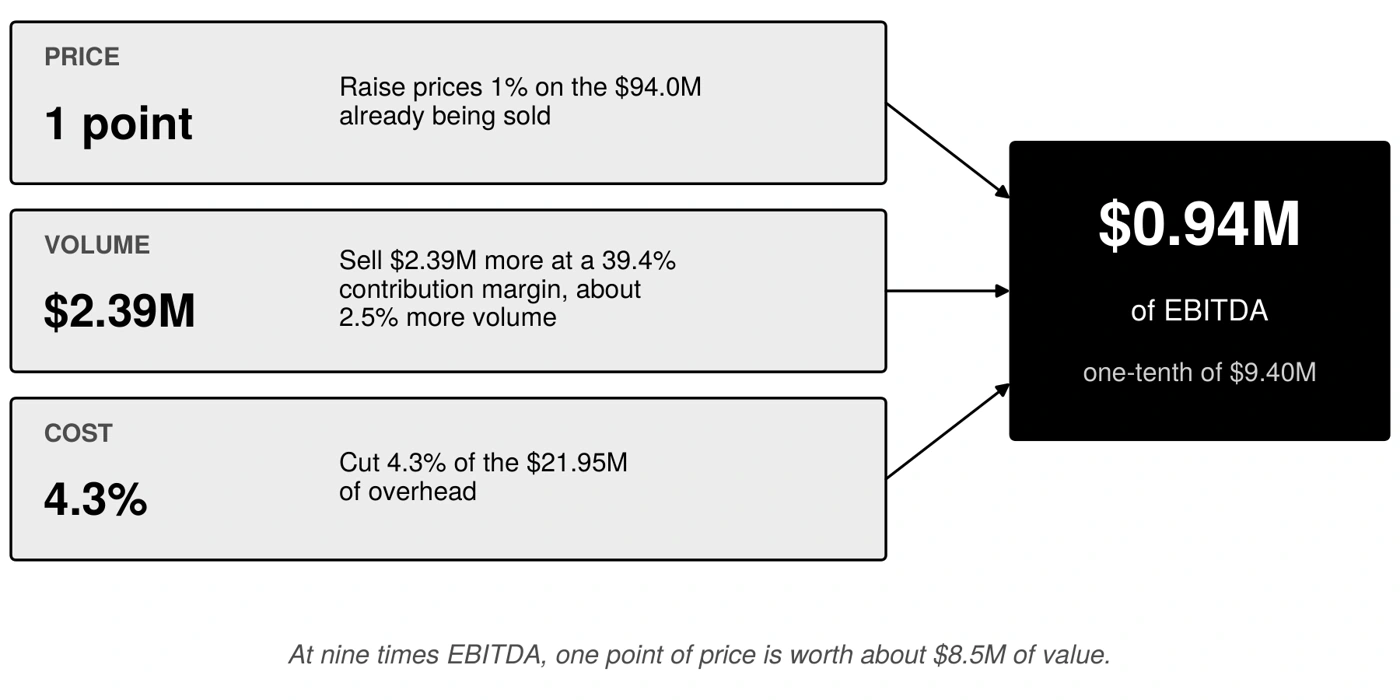
Claire did the arithmetic on a legal pad (Figure 01-01). One point of price on $94.0 million was $0.94 million, a tenth of EBITDA. To earn the same $0.94 million from volume, at the blended 39.4 percent contribution margin of the three lines, Millrace would have to sell $2.39 million more, about 2.5 percent more volume. To earn it from cost would mean cutting 4.3 percent of the $21.95 million of overhead. At nine times EBITDA, the multiple Millrace’s owners used to value the company, that one point was worth about $8.5 million.
She picked a date to begin: Tuesday 2 September, the day after Labor Day. Beside it she wrote “Day 1.”
Do This
- Pull the last twenty invoices for your top-selling item and write beside each who set that price.
- Compute your one-point number (1 percent of revenue) and what share of EBITDA it is.
- Compute the new revenue you would need to earn the same dollars from volume, at your contribution margin.
- List the date each price element last changed: the list, the labor rate, the freight rule, the discount schedule, the dealer tiers.
- Ask five leaders, separately, who owns price, and lay their answers side by side.
- Put price first on the next leadership agenda.
Five answers mean the price is everybody’s business. Step 1 makes it somebody’s.